Viva Trees
Get a FREE professional tree service estimate from Viva Trees - one of the most trusted tree companies in the U.S.
OR CALL
Get a Free Estimate
Every project starts with a free tree service estimate. Enter your details to get started.

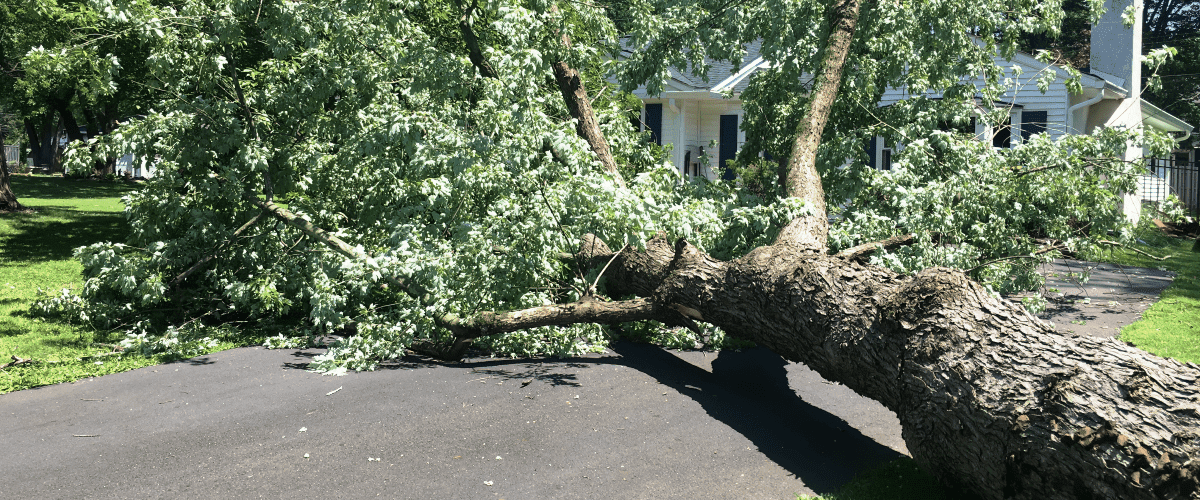
As an arborist, I understand the importance of preparing trees for storms and supporting systems’ role in keeping them safer. Storms can damage the tree and your property significantly, but you can reduce the risks by being ready.
In this guide, I will explain everything you need to know about tree storm prep and support systems, including cabling and bracing, anchoring systems, and lightning protection systems. I will discuss how these systems work, when to use them, and how to choose the right one for your specific tree.
Before we get into the existing support systems, let me provide a quick overview of why we install support systems in the first place.
Tree companies install tree support systems for several reasons, the most crucial being to reduce the risk of tree failure. Failure of a tree can mean the tree falling over or breaking, which can cause significant damage to property, power lines, or even injury to people.
Some main reasons are weak branch unions, including codominant stems, also known as included bark. This can cause the branches to fail. Cabling and bracing systems can help distribute the load and keep the branches together.
Another reason is to support long, heavy limbs. A tree may have a stem that is too long, heavy, or weak to support its weight and is at risk of breaking. Cabling or bracing can help support the limb and prevent it from breaking.
Lastly, tree companies also install support systems for entire trees. This is known as “guying,” which consists of installing cables and anchors near the tree’s base and attaching them to wires or straps that run up the tree. This helps to hold the tree in place and prevent it from falling or being uprooted during a storm.
It’s worth noting that installing support systems does not make a tree safe; they reduce the risk of failure and help to extend the tree’s life. The support systems must be inspected and maintained regularly; the tree’s safety can be compromised over time.
A tree risk assessment is usually done before determining whether a tree requires support.
Regular tree assessments are essential for maintaining the health and beauty of your trees. Check out our new page on why you should have your trees assessed to learn about the benefits of tree assessments and how they can help prevent costly damage to your property.
Now that we have covered why support systems are installed let’s discuss the available types.
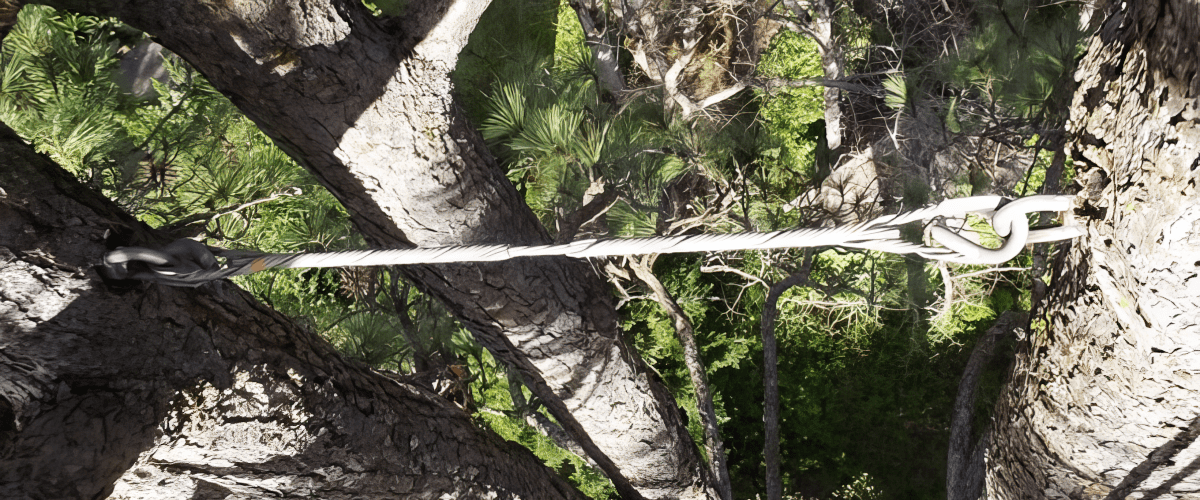
Cabling and bracing provide extra support for trees at risk of failure. This includes supporting weak branches, heavy limbs, or the entire tree. The process helps distribute the load. A thorough inspection of the tree and pruning should be done before installation.
Cabling is typically used for trees with a V-shaped crotch or multiple leaders (more than one trunk growing out of the same point). This is because V-shaped crotches are weaker and less stable than U-shaped crotches, and multiple leaders can compete for nutrients and water, making the tree more likely to fail.
Bracing, however, is typically used for trees with a split or cracked trunk or major limbs. This is because breaks or cracks can weaken the structural integrity and make it more susceptible to branch or trunk failure. Bracing involves attaching metal plates or rods to the affected area to help hold it together.
It’s important to note that cabling and bracing are not permanent solutions. The systems must be regularly inspected and maintained to ensure they still provide the necessary support. According to the National Arborist Association (NAA), cables should be inspected annually, and any signs of rust, fraying, or other damage should be addressed immediately. On the other hand, braces typically have a longer lifespan but should still be inspected every 3-5 years.
When selecting the right type and size of cables and braces, it’s essential to consider the tree’s size, species, and condition and the potential risks in the area. As an arborist, I always consider the weight, possible wind speeds, and direction of the prevailing winds in the area.
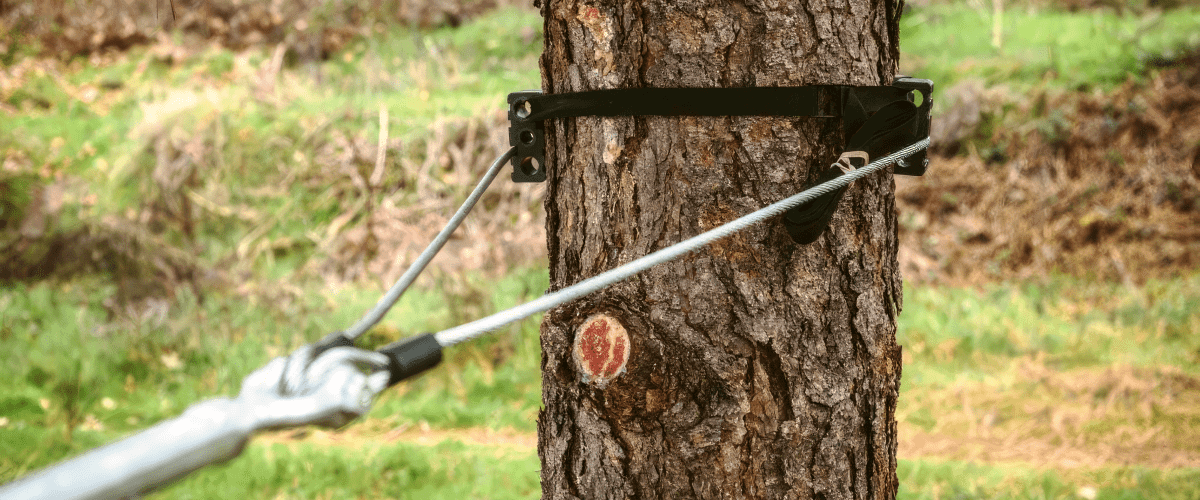
Anchoring systems are another type of support system that can be used to keep trees safer during storm season. These systems involve installing one or more anchors in the ground near the base, which are then attached to cables or straps that run up through the trunk. The anchors help hold the tree in place and prevent it from falling or being uprooted.
Most of the time, anchoring systems are used on trees that could be uprooted or pushed over by strong winds or heavy rain. This can include the ones growing on a slope, near a body of water, or in an area susceptible to soil erosion.
When choosing the right type and size of anchors, it’s crucial to consider the size, species, and condition of the tree and the potential risks in the area. According to the ISA (International Society of Arboriculture), the anchors should withstand the tree’s weight and the wind load, and the cables should be strong enough to keep the tree upright.
Tree anchoring systems also require regular inspection and maintenance. It’s essential to check the tightness and condition of the cables and anchors every year and to replace them if they show signs of wear or damage.
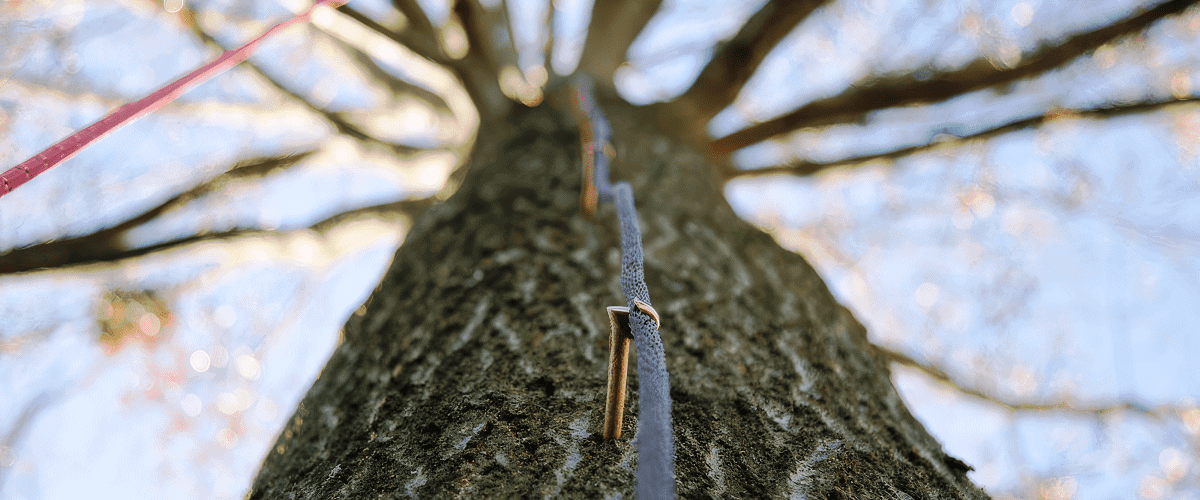
Lightning protection systems are designed to protect trees from lightning strikes. These systems involve installing a series of grounded conductors that run from the top of the trunk to the base, connected to a ground rod. The conductors are intended to intercept a lightning strike and safely channel the electricity into the ground, reducing the risk of damage to the tree or nearby property.
It’s important to note that a lightning protection system does not guarantee that a tree will not be damaged or destroyed by a lightning strike. Still, it dramatically decreases the chance of it being hit and can reduce the damage done to it if it is to get hit.
These systems are typically used for tall, isolated trees at a high risk of being struck by lightning. This includes those in open fields, near power lines, or hilltops. A lightning protection system is also worth considering for those close to essential buildings or structures.
When choosing the right ones, it’s essential to consider the size and species of the tree, as well as the potential risks in the area. According to National Lightning Safety Institute, the system should be designed to accommodate the tree’s height and adequately grounded to ensure it works as intended.
Like the other systems, a lightning protection system also requires regular inspection and maintenance. The conductors should be checked for wear or damage every year, and the ground connection should be checked to ensure it is still secure.
Choosing a tree service company with experience is vital before deciding. There are specific requirements needed to install them correctly.
Here are some common mistakes I’ve seen made by tree companies.

When installing tree support systems such as cabling/bracing, anchoring, and lightning protection, several common mistakes are often made, which include:
Again, I will repeat. Working with a professional arborist is essential to ensuring that the support systems are correctly installed and appropriate for the specific tree and the area’s conditions.
Finally, I will cover some of the questions our customers ask.
Below are some commonly asked questions I get from homeowners and business owners.
The lifespan of a cabling and bracing system can vary depending on various factors, such as the size and species of the tree, the type and quality of the materials used, and the conditions in the area. However, as a general rule, cables should be inspected annually, and if any signs of rust, fraying, or other damage are found, they should be replaced immediately. The cable’s lifespan depends on the environment it is exposed to, the material used, and if regular maintenance is done.
On the other hand, braces typically have a longer lifespan than cables. They are designed to hold the tree together and are typically made of metal plates or rods attached to them. However, inspecting the braces every 3–5 years is essential to ensure they provide the necessary support and no rust or damage is found.
It’s important to note that cabling and bracing are not permanent solutions. The systems must be inspected and maintained regularly to ensure they still provide the necessary support. If there’s any sign that the system is no longer providing adequate support, it’s essential to consider removing or replacing the system as soon as possible.
Anchoring systems are designed to provide extra support to trees at risk of falling or being uprooted, but they can cause damage to the roots if not installed or maintained correctly.
Proper installation of the anchors is critical to preventing damage to the roots. The anchors should be installed at least 2 feet from the trunk and no closer than 18 inches to the root flare. This allows enough space for the roots to grow without being constricted or compacted. Also, appropriately sized anchors and not overtightening the cables are vital to prevent damage to the bark or roots.
Proper maintenance is also crucial to prevent damage to the roots. The cables and anchors should be checked for wear or damage regularly, and any signs of damage should be addressed immediately. Also, if the tree outgrows the support of the system or the structural issues are no longer present, removing the anchoring system is essential to prevent any damage to the roots.
Working with a professional arborist when installing an anchoring system is essential. They can help determine the best location for the anchors and adequately install the system to minimize the risk of root damage.
The cost of installing a lightning protection system can vary depending on various factors, such as the size and species of the tree, the type and quality of the materials used, and the complexity of the installation. Generally, a lightning protection system can be expensive compared to cabling and bracing, but it’s not considered high-end.
The cost of materials for a basic lightning protection system can range from a few hundred to several thousand dollars, depending on the size and height of the tree, the materials used, and the complexity of the installation. However, it’s worth noting that the cost of a lightning protection system can be much lower than that of repairing or replacing a tree damaged or destroyed by lightning.
A lightning protection system requires regular inspection and maintenance to ensure it is still working correctly and providing adequate protection. The conductors should be checked for wear or damage every year, and the ground connection should be checked to ensure it is still secure. The homeowner, a professional arborist, or a lightning protection specialist can perform these maintenance tasks. The cost of maintenance is usually less expensive than the cost of installation, typically running a few hundred dollars per year.
To sum up, lightning protection systems can indeed be considered expensive. Still, the benefits of protecting a valuable tree and the peace of mind that comes with knowing that it is less likely to be damaged or destroyed by lightning can make it a wise investment in the long run.
Storm prep and support systems, such as cabling and bracing, anchoring systems, and lightning protection systems, can be used for many types of trees, but they may only be suitable for some species or situations.
As mentioned above, cabling and bracing are generally used for trees with structural weaknesses, such as a V-shaped crotch or split trunk. This technique is suitable for most deciduous and evergreens with a trunk diameter of at least 8 inches and whose height exceeds 25 ft. However, it may not be appropriate for smaller trees or those with different structural weaknesses that cannot be addressed with cables and braces.
On the other hand, anchoring systems are generally used for trees at risk of being uprooted or pushed over due to high winds or heavy rain. This can include those growing on a slope, near a body of water, or in an area susceptible to soil erosion. Depending on the size, species, and soil conditions, these systems can be used on most trees.
Lightning protection systems can be used for most tall, isolated trees at high risk of being struck by lightning. This includes those in open fields, near power lines, or hilltops. However, lightning protection may not be needed for certain species that grow to be much smaller or for specific locations.
In all cases, working with a professional arborist is essential to determine whether storm prep and support systems are appropriate for your situation. An arborist can assess the tree’s overall health and structure, evaluate the risks in the area, and recommend the most appropriate course of action to reduce the risk of failure and extend the tree’s life.
In conclusion, preparing trees for storms is crucial for keeping them safer and protecting property. Cabling and bracing, anchoring systems, and lightning protection systems are all effective ways of providing extra support and reducing the risks of damage. However, it’s important to remember that these systems are not a permanent solution and do not guarantee your trees’ safety. Regular tree inspection and maintenance are necessary to ensure they still provide support.
It’s also important to understand that every tree is unique and that there isn’t a one-size-fits-all solution. Contact a professional arborist to assess the tree risks and choose the appropriate support systems. We follow strict ANSI A300 guidelines at Viva Trees when installing support systems, including the hardware requirements for static cable systems.
I recommend homeowners and business owners take proactive steps to prepare their properties for storms and keep them safe. If you have any questions or concerns, please get in touch with us for guidance.
If you liked this blog, check out our other tree care and maintenance articles on: