Viva Trees
Get a FREE professional tree service estimate from Viva Trees - one of the most trusted tree companies in the U.S.
OR CALL
Get a Free Estimate
Every project starts with a free tree service estimate. Enter your details to get started.

Trees are an attractive and necessary part of the landscape, providing shade, oxygen, and a home for various wildlife.
But sometimes, cutting down a tree’s crown is necessary to keep people and the environment safe. This process involves removing certain tree branches to maintain the tree’s health and size.
It can also protect people and property from damage caused by dead branches or other problems.
In this Viva Tips article, we will discuss the importance of tree crown reduction services, also known as “tree crowning,” and how they can benefit both the environment and people. By understanding how vital this standard method is, we can ensure that our trees stay safe and healthy for many years.
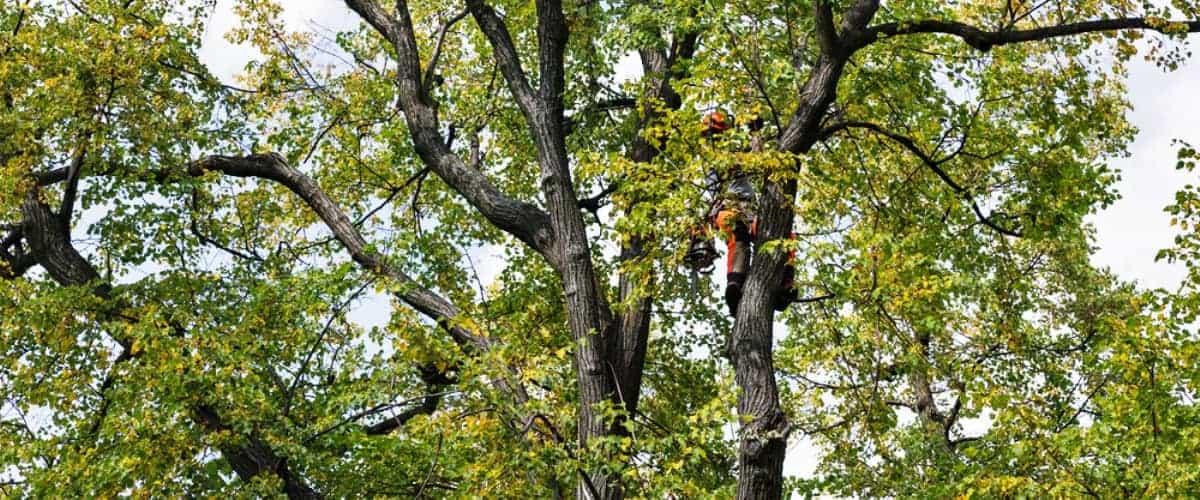
Tree crown reduction is a pruning technique that reduces the overall size of a tree’s canopy by selectively removing weak branches.
Reducing the tree’s crown makes it smaller while keeping its natural shape and form.
This can be done for various reasons, including reducing the risk of wind damage, improving the tree’s appearance, or increasing the amount of sunlight that reaches the ground beneath the tree.
An arborist will first look at the tree for a crown reduction to determine how much foliage should be cut away. Then, they will carefully cut away branches using pruning techniques to put as little stress on the tree as possible. This may involve cutting branches back to a lateral branch, the tree’s trunk, or removing entire branches if necessary.
With Viva Tips’ tree care guide, ensure your trees are healthy and thriving. This guide covers all aspects of tree care, including inspecting the roots, trunk, branches, and leaves to keep your trees in tip-top shape.
A crown reduction service is a task that a certified arborist should only do because it requires a deep understanding of tree biology. Plus, it can be dangerous if not done right.
There are several reasons why a tree may need its crown reduced:
To perform a crown reduction, an arborist will follow these steps:
Crown thinning, crown lift (or crown raising), and crown reduction are all ways to prune a tree by removing branches to change its shape or size.
However, each technique involves the removal of different types of branches and has a different overall effect on the tree.
Crown thinning is the selective removal of branches from the canopy of a tree to reduce its density and increase light and air circulation.
The goal of crown thinning is to maintain the overall size and shape of the tree while thinning out the canopy to create a more open and airy appearance.
A Crown lift, called “crown raising,” cuts off the lower tree branches to make more space under the canopy.
This can be done to improve the tree’s appearance, allow for the passage of people or vehicles underneath, or provide tree access for maintenance.
Crown reduction, on the other hand, involves taking out certain branches to make the tree’s canopy smaller.
This can be done to reduce the risk of wind damage, to improve the tree’s appearance, or to increase the amount of sunlight that reaches the ground beneath the entire tree.
Tree crown reduction is integral to improving overgrown trees’ overall health. This process can also reduce the amount of foliage to reduce shading and wind exposure. Cutting down a tree’s crown size can make spotting problems or potential pests easier. This makes it possible to treat and prevent problems better.
Additionally, pruning the crown of a tree can reduce the chance of storm damage, which can help protect the tree’s health and safety.
Tree crown reduction is an essential tool for reducing storm damage. Reducing the tree’s overall size and height decreases the likelihood of large limbs breaking off in high winds and heavy rains.
When the size of the tree’s canopy is reduced, the surface area exposed to strong winds is also reduced. This allows the tree to withstand inclement weather.
Additionally, reducing the tree’s overall size can help keep it from becoming uprooted in storms. All of these things make tree crown reduction a vital way to keep storm damage from happening.
Tree crown reduction is the process of selectively pruning the branches of a tree to reduce its size and enhance its appearance. Reducing the size of the tree’s crown can be beneficial in several ways.
Not only does it reduce the risk of branches falling and causing damage, but it can also open up the view of the tree, creating an aesthetically pleasing look.
When done right, crown reduction improves the tree’s look while letting it grow and thrive.
Tree crown reduction is essential to landscaping because it can make your property look better. You can create a more aesthetically pleasing visual scene by reducing the crown size.
You can cut off branches or trim the crown to your desired shape. The landscape’s overall appearance can be more attractive, and the tree can be left healthier and more structurally sound.
Tree crown reduction is essential to tree care and should be done regularly to keep your trees looking their best.
Tree crown reduction is an integral part of tree care and maintenance, as it can increase the life span of a tree. The tree can reduce the risk of disease or damage due to storms and weather by reducing the crown size.
Also, cutting back on the crown size lets more light reach the lower branches, which can help the tree grow healthier.
A crown reduction also improves the flow of air around the tree, which is essential for its health.
Lastly, reducing the tree’s crown can help reduce the amount of debris it makes, which can be a nuisance and a safety risk.
By removing branches crossing or rubbing against each other, a crown reduction can help improve the tree’s overall structure and stability.
This can be especially important in cases where the tree has become overgrown or its canopy is uneven.
Removing branches can also help increase the amount of light and air circulation within the tree’s canopy.
This can be beneficial for the tree’s overall health, as well as for the plants and other vegetation growing beneath the tree.
In some cases, a crown reduction can reduce the risk of wind damage to a tree. By reducing the overall size of the canopy, the tree becomes less susceptible to strong winds, which can help prevent branches from breaking or being damaged.
Here are some do’s and don’ts to consider when it comes to crown reduction, lifting, or thinning of older, mature trees:
Work with a certified arborist. To prune a tree, you must work with a certified arborist. They have the knowledge and experience to prune your tree safely and effectively.
Use the correct pruning methods. The tree maintenance service should use proper pruning methods, like making cuts at the right angle and using the three-cut method to keep the bark from tearing.
Consider the tree’s species and location: Different tree species have different pruning needs, and the tree’s location can also affect the appropriate pruning techniques. The arborist should consider these factors when performing the pruning.
Leave enough foliage: It is essential to leave enough foliage on the tree to support its overall health and well-being. The arborist should look at the tree carefully and decide how much of its leaves to take off.
Remove more than 25% of the canopy: It is generally not recommended to remove more than 25% of the canopy of an older, mature tree in a single year. Removing too much foliage at once can stress the tree and result in long-term damage or even death.
Remove all branches from one side of the tree: Maintaining a balanced canopy when pruning a tree is crucial. Removing all the branches from one side of the tree can create an uneven canopy and increase the risk of wind damage.
Make flush cuts: Flush cuts, where the branch is cut directly against the tree’s trunk, can damage the tree and leave it vulnerable to decay. Instead, the arborist should prune just outside the branch collar, the raised area where the branch meets the trunk.
Prune at the wrong time of year: Different tree species have different optimal times for pruning. When pruning, the arborist should consider the type of tree and the time of year to put as little stress on the tree as possible.
Tree crown reduction is an essential tree service for maintaining tree health, safety, and aesthetics. It can keep trees from getting too big, lower the risk of damage to branches or roots, and keep the area around the trees looking nice.
When done correctly and safely, tree services can also help promote healthy growth and enhance the beauty of a tree. It’s essential to seek the help of a professional tree company to ensure the job is done correctly and safely.
If you liked this blog, check out our other tree care and maintenance articles on: